Getting the course ready
Before the course, I helped assemble BlueBoats, small uncrewed catamarans used for the exercises. I also worked on computer-aided designs for parts and on component orders, organized equipment, edited MOOS-IvP missions and code, and ran simulations to prepare the exercises students would use in class and during field tests.
Teaching in Piraeus
During the course I was mainly a classroom teaching assistant. I helped students understand the missions, work through unfamiliar MOOS-IvP concepts, and see why a simulation or configuration behaved the way it did. I also helped with some on-water troubleshooting, though I wasn’t leading the field exercises.
The class brought together about 25 military and civilian participants, many already well into their careers. As they moved from simulation to field testing, a working configuration became something they could watch a real boat execute. Helping them connect the behavior files, messages, and vehicle motion was a particularly rewarding part of teaching the course.
The prime minister’s visit
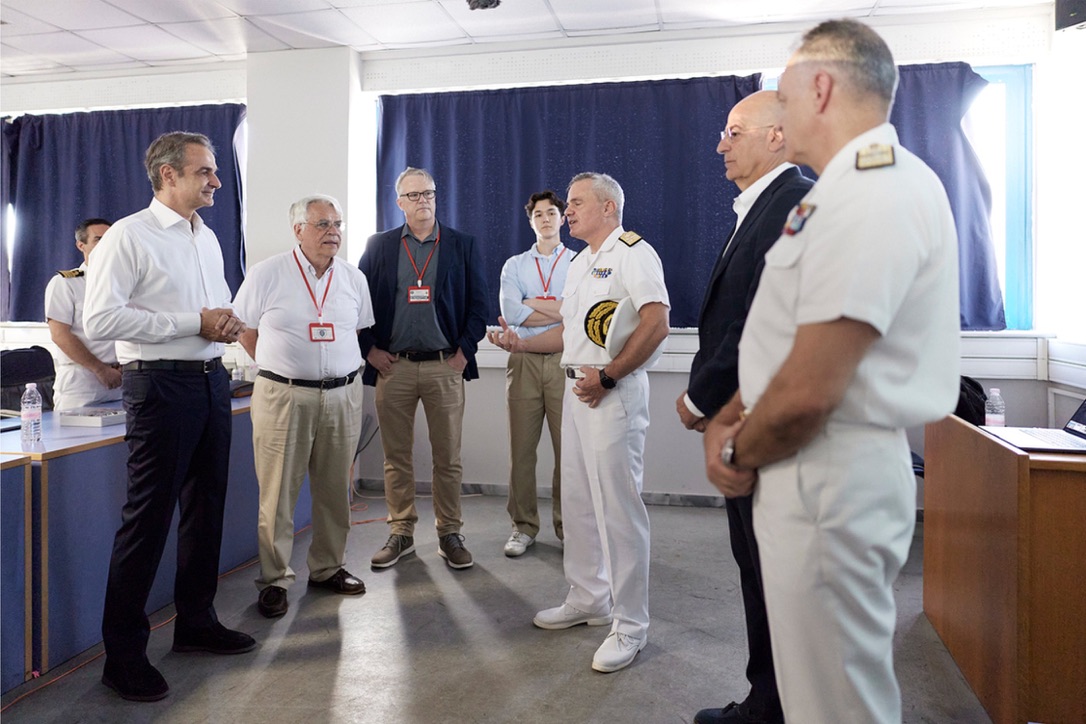
On June 25, 2026, the experience culminated in a presentation to Prime Minister Kyriakos Mitsotakis, Defense Minister Nikos Dendias, and senior members of the Greek military. Michael Triantafyllou and Michael Benjamin briefed them on the MIT TRITON course, followed by a demonstration of the unmanned surface vehicles. I also had the chance to exchange a few words with the visiting officials.
The visitors included General Dimitrios Choupis, chief of the Hellenic National Defence General Staff; Vice Admiral Dimitrios-Eleftherios Kataras, chief of the Hellenic Navy General Staff; Rear Admiral Ioannis Retsas, commandant of the academy; and Pantelis Tzortzakis, CEO of the Hellenic Centre for Defence Innovation. Other government officials and senior naval officers also attended.
The visit covered both the laboratory work and the harbor demonstrations. The academy’s commandant explained that the course materials and systems would remain in Greece for future classes, giving the preparation and teaching work a life beyond those two weeks.
A source-grounded teaching assistant
I assembled MIT and MOOS-IvP course material into an assistant built with Google’s NotebookLM, an AI tool that answers questions using supplied sources. It helped with conceptual questions and beginner debugging, with references students could follow back to the course material. Before trying it with the class, I tested it on a fixed set of lab-grounded prompts and preserved the source packs, responses, and scoring notes in a public repository.
The source collection contains 49 PDF packs, and the evaluation covers 60 questions across conceptual debugging, precise documentation lookups, and code or configuration problems. That includes the kinds of questions a student asks when a mission won’t launch or a behavior won’t activate, as well as questions where an invented parameter would be worse than admitting uncertainty.
I scored answers for correctness and practical usefulness, checking concrete claims against the material rather than rewarding confident explanations. The rubric treats invented tools, incorrect configuration syntax, and unsupported certainty as errors. Comparing responses from other assistants also helped me examine what a curated course-specific source collection adds. It’s an evaluation of answers to prepared questions, not a measurement of how much students learned.
Feedback from the class
After the course, I collected ten responses about the NotebookLM assistant and MOOS-IvP Skills, my plugin of workflows for AI coding assistants. Participants described using NotebookLM to find information across the course material, understand unfamiliar concepts, and organize their study. Several found it easy to start using, including people who already used other AI tools regularly.
Participants also described putting Skills to work in the labs. One used them to test a proportional-integral-derivative (PID) controller, which adjusts a vehicle’s response to keep it on target, and choose how strongly it should correct an error. Others found them helpful for app development and working through the exercises. The feedback included interest in continuing to use the tools for future MOOS-IvP projects. Seeing people use them for their own questions and experiments added a classroom perspective to the prepared-question benchmark.